

Written by Dr Michelle Wilson, Medical Oncologist & ANZGOG New Zealand Director
Introduction
The Australia New Zealand Gynaecological Oncology Group (ANZGOG) held their 2023 Annual Scientific Meeting titled “Improving the Lived Experience of Patients with Gynaecological Cancers” on 22nd-24th March in Brisbane, with a record breaking 324 delegates attending the meeting in person. With fabulous international and local speakers, an amazing programme and a theme central to what we all do, the meeting was the best way to celebrate what we have achieved and where we are going.

International keynote speakers, Prof Rene Pareja (left) and Prof Iain McNeish (right).
Opening day
We started with a new workshop titled “Developing your Research Career: Trials and Tribulations” which was chaired by the amazing A/Prof Emma Allanson and Dr Michelle McMullen. This was a masterclass for any early career researchers as they navigate their way to turn an idea into a concept and then finally into a study. The transdisciplinary team of clinicians, nurses, patient advocates led the audience through important considerations for any research project. Examples from previous work and the lessons learned were presented by experienced researchers with the power of the team highlighted throughout this session. They imparted many pearls of wisdom with the key message to reach out and speak with your colleagues and never be afraid to ask for help.
The afternoon included five simultaneously run workshops: Radiation Oncology (chaired by Drs David Chang and Alison Salkeld); Gynae Nurses (chaired by Anne Mellon); Consumer Education (chaired by Wanda Lawson); Study Coordinators (chaired by Donna Long); and Gestational Trophoblastic Disease (chaired by Dr Michael Burling and A/Prof Emma Allanson). Each session included topics relevant to Improving the Lived Experience of Patients with Gynaecological Cancer.
International speaker Dr Ina Jürgenliemk-Schulz led discussions on the advanced treatments in cervical cancer in the Radiation Oncology Workshop. Vulval cancer was a key elements in the Nursing and Consumer workshop which is a challenge in daily clinical practice. The potential impact of teletrials for delivering research to more individuals across Australia and New Zealand is exciting and is an important area to continue to explore. The GTD sessions included education and case based discussions alongside learned lessons from developing registries. The chairs and presenters did a phenomenal job in the planning of these sessions to make them relevant to all that attended.
At the same time the exceptional Pure Science Symposium, chaired by A/Prof Kylie Gorringe, Prof Deborah Marsh, and Prof Nikola Bowden was underway. We were spoilt by dazzling scientists from both New Zealand and Australia and even a virtual speaker Dr Goli Samimi all the way from the USA. Topics ranged from use of the media, immunotherapy, to cancer genetics. Amongst this were five abstracts presented on current research initiatives. The session left people inspired by local talent and what might be possible to improve care for individuals with gynaecological cancer. It emphasised the collaboration in bringing the science to the bedside and back again.
The day finished with a poster presentation with each respective talented researcher describing their work for two minutes. This was followed by the welcome ceremony led by Prof Clare Scott AM – Chair of ANZGOG.
Day 2

ANZGOG Chair – Prof Clare Scott AM, providing an update of ANZGOG’s activities.
The meeting was officially opened by Prof Clare Scott AM as ANZGOG Chair.
Our keynote international speakers were Prof Rene Pareja (Gynaecological Oncologist, National Cancer Institute Bogotá, Columbia), Dr Ina Jürgenliemk-Schulz (Radiation Oncologist, University Medical Center Utrecht, Netherlands) and Prof Iain McNeish (Medical Oncologist, Imperial College London, England). This was the first time since 2019 we have had all our main conference speakers in person. For this session the speakers summarised the key advances in surgery, radiation oncology and medical oncology over the last 100, 10 and 5 years respectively – all of which have led to improvements in both the quality and quantity of life, for individuals with gynaecological cancer experience today. It was great to reflect back on where we have come from and where we are today – celebrating the success of clinicians and scientists internationally in shaping the care for individuals with gynaecological cancer.

International keynote speaker, Dr Ina Jürgenliemk-Schulz.
Moving to the uterine session, the focus was on what we need to consider to help women live better with this disease. With the increasing rates of endometrial cancer in premenopausal women, we opened the session with important considerations for this cohort of women led by Prof Andreas Obermair. Dr Ruth Angell led a discussion on the toxicities associated with radiation and opportunities for management and research in this area. Dr George Au-Yeung concluded the session with a discussion on how molecular profiling impacts what we do today and how this might impact our discussions moving forward. This is an important area of progress, with research continuing to define how we will use this in day to day practice and discussions.
Next, we heard an update from Prof Clare Scott on the progress within ANZGOG. This was alongside an update about the fabulous fundraising efforts and educational opportunities, namely the WomenCan Larapinta Trek (anybody that is interested, please speak to Karen Livingstone AM) and Survivors Teaching Students (Dr Helen Gooden).
Following lunch, the cervical and vulval session included presentations from our international speakers Prof Pareja and Dr Jürgenliemk-Schulz on fertility sparing opportunities and radiation techniques. Dr Yeh Chen Lee provided a summary on novel targets in adenocarcinoma of the cervix and vulva and ways to move forward.
ANZGOG continues to thrive with our research initiatives across gynaecological cancer types. We celebrated the success of the EDEN Initiative, TR-ANZGOG and OASIS. These initiatives continue to create opportunities to advance our understanding and improve outcomes for individuals with gynaecologic cancers.
The day concluded with a tumour board. Assembled was a fantastic group of specialists with a formidable knowledge base to draw upon as we explored our two cases. The discussion on the complexities of the case was extremely valuable.
Our conference dinner was held in the Hilton Grand Ballroom. ANZGOG’s 2023 Recognition Awards were presented to Prof Linda Mileshkin, Prof David Bowtell, Dr Nikki Burdett, Mr Duncan McPherson OAM and to the Newcastle Private Clinical Trial Unit for their outstanding work in research and fundraising in support of ANZGOG. Dr Alison Davis was also recognized and thanked as the outgoing Chair of the ANZGOG Research Advisory Committee. It was a great opportunity to catch up with international colleagues and celebrate being together in person again.
Day 3
We opened the final day with the Quality of Life and Survivorship Symposium. This session included fantastic talks from Dr Charlotte Seib on the prevalence and correlates of distress for women with gynaecological cancer and Prof Sandi Hayes on the importance of exercise. Practical recommendations for integration and consideration in practice were weaved into each presentation. A/Prof Trevor Tejada-Berges gave an insightful talk on the challenges faced by transgender people with gynaecological cancer. It raised important aspects of care that need consideration in improving their lived experience.
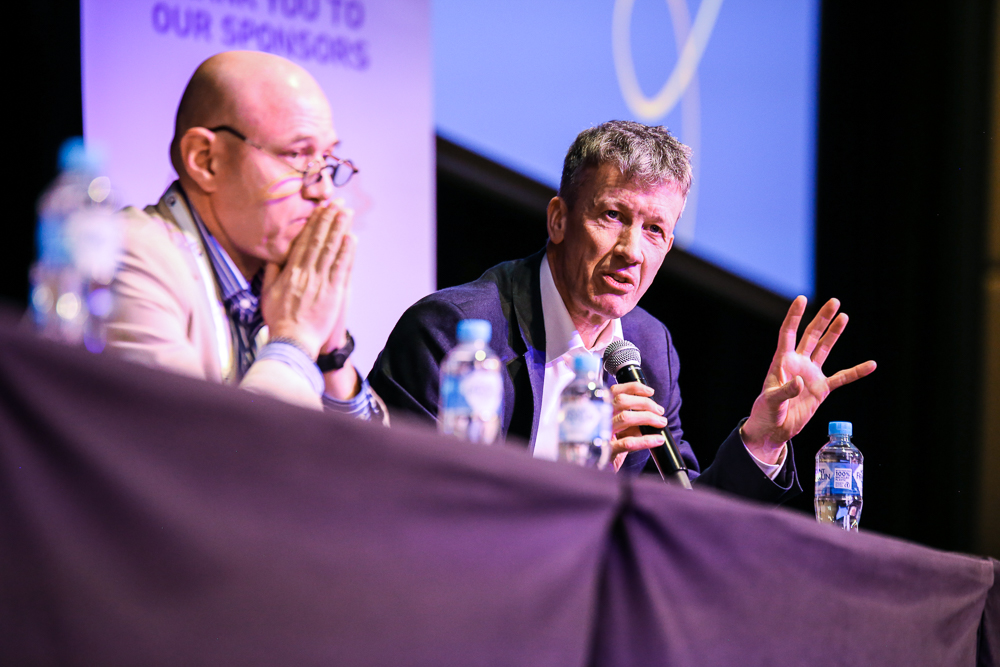
With a focus on equity and diversity, Drs Abhijit Pal and Rayan Saleh Moussa presented the challenges and practical solutions to improve equity and diversity in clinical trials. They discussed barriers and opportunities for ANZGOG to consider in trial design and conduct to make more research possible for more individuals with gynaecological cancer. This session concluded with a panel discussion where they were joined by A/Prof Kate Webber and Dr Lawrence Kasherman.

Dr Janine Lombard (right) speaking on the panel, accompanied by Prof Nikola Bowden (left).
The next session of the day led by Dr Alison Davis and Prof Paul Cohen discussed opportunities and support for developing trials with ANZGOG and introduced the NSW Cancer Clinical Academic Group. Over the course of the main conference four novel concepts were presented and discussed. These all explore opportunities to help women live better in line with the core goals of ANZGOG.
This was followed by updates on recruiting trials locally and internationally that ANZGOG are contributing to. It is exciting to see the progress in this space and what lies ahead with future trials across Australasia.
Following lunch, the ovarian session was chaired by A/Prof Emma Allanson and Dr Michelle Harrison. International speaker Prof Iain McNeish opened this session with an enlightening talk on how we decode chaos and unravel the genomic of high grade serous carcinoma from diagnosis and relapse. It highlighted how this translates to the clinical challenges we face in clinic in managing this disease. A/Prof Rhonda Farrell provided a comprehensive update on the timing and mode of surgery in advanced ovarian cancer. Prof Clare Scott concluded the session with updates of two rare ovarian cancers – clear cell and mucinous ovarian cancer – and opportunities in this space for treatment and research moving forward.
The final session of the day centred on the challenges in gynaecological cancer. Dr Bryony Simcock presented on endometrial cancer and the daunting rates of obesity seen in children today. This is leading to increasing rates of this disease in young women and needs recognition. Prof Paul Cohen followed this session with an entertaining and insightful talk on time management and tips for a building a successful research area.
The meeting was closed by Prof Clare Scott. Many thanks to the very hard working ASM 2023 Program Steering Committee with special mention to the Chair Dr Michelle Harrison and Deputy Chair A/Prof Yoland Antill, ANZGOG, ASN, and our sponsors. This would not be possible without the endless enthusiasm and drive from both Dr Michelle Harrison and A/Prof Yoland Antill. We look forward to seeing you in 2024.
For more information about ANZGOG, please visit the website.