

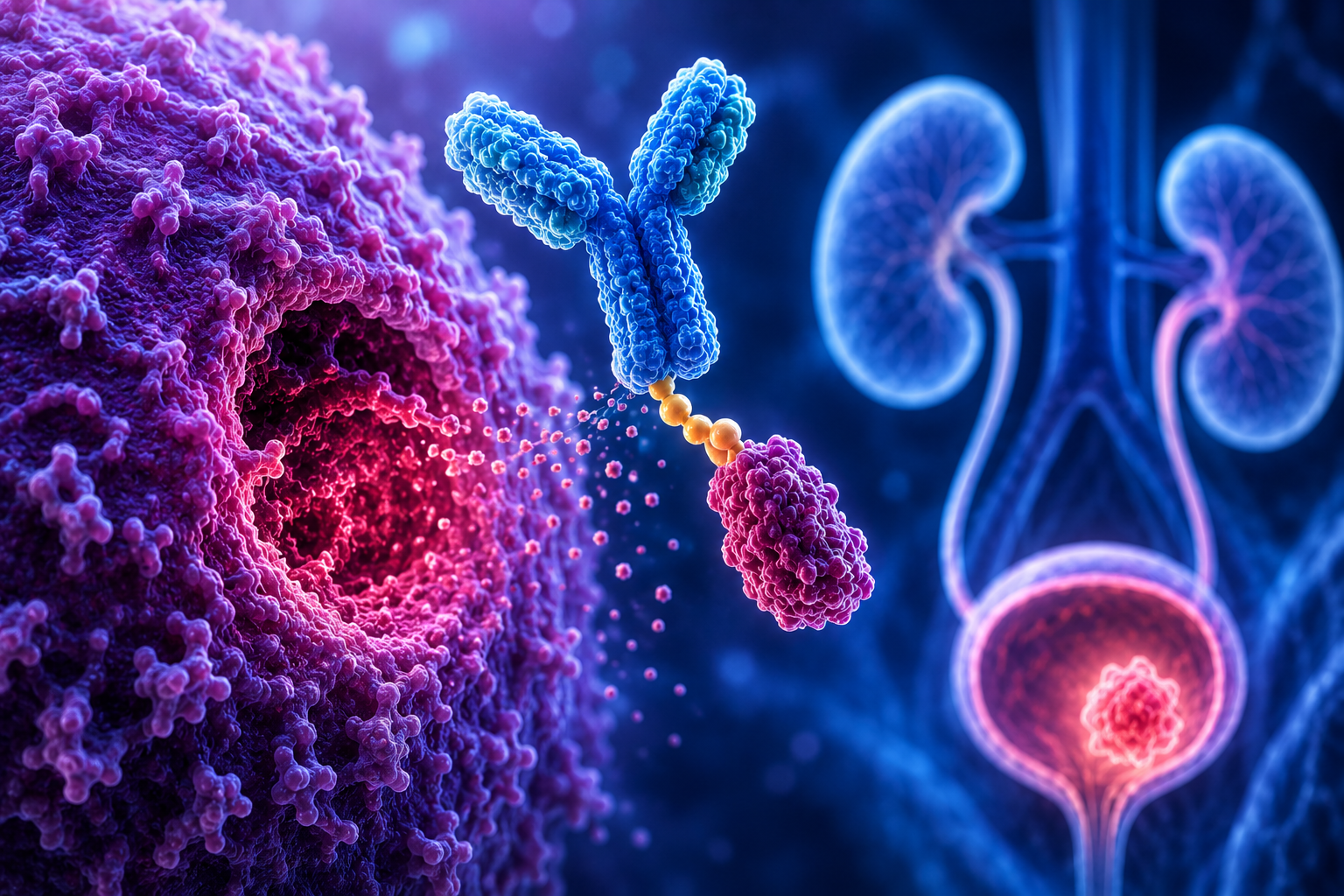
Antibody-drug conjugates (ADCs) continue to demonstrate substantial activity in locally advanced and metastatic urothelial carcinoma, according to a systematic review and meta-analysis published in JAMA Network Open.
The analysis evaluated evidence from 40 interventional and observational studies involving 6,085 patients treated with ADCs, including enfortumab vedotin, disitamab vedotin and sacituzumab govitecan. Researchers sought to assess how these agents perform across both clinical trial and real-world settings as their role in urothelial cancer continues to expand.
 LISTEN TO DR NIARA OLIVEIRA + DR VIVEK RATHI BUSTING SOME BRCA MYTHS!
Among the findings, enfortumab vedotin monotherapy demonstrated remarkably consistent objective response rates between interventional studies and real-world cohorts, achieving response rates of 43.9% and 44.6%, respectively. The authors noted that these results support the translation of clinical trial outcomes into routine practice.
Combination approaches produced even higher response rates. Enfortumab vedotin combined with pembrolizumab was associated with an objective response rate of 67.5% overall and 65.4% among cisplatin-ineligible patients. In interventional studies, disitamab vedotin combined with PD-1 inhibitors achieved objective response rates approaching 75%, although the available evidence remains more limited than that supporting enfortumab vedotin. These findings highlight growing interest in ADC-immunotherapy combinations for advanced urothelial carcinoma.
CLINICAL SUMMARY
What was examined
A systematic review and meta-analysis of 40 interventional and observational studies involving 6,085 patients evaluated the efficacy of antibody-drug conjugates in locally advanced and metastatic urothelial carcinoma.
Key findings
- Enfortumab vedotin monotherapy demonstrated similar objective response rates in clinical trials (43.9%) and real-world studies (44.6%).
- Enfortumab vedotin plus pembrolizumab achieved objective response rates of approximately 67%, while disitamab vedotin combined with PD-1 inhibitors produced response rates approaching 75% in interventional studies.
- Network meta-analysis suggested a potential overall survival advantage for enfortumab vedotin compared with chemotherapy in cisplatin-ineligible patients.
Clinical implications
- The findings add to evidence supporting ADCs as active treatment options in advanced urothelial carcinoma.
- Consistent outcomes observed in clinical trials and routine practice provide reassurance regarding the real-world effectiveness of enfortumab vedotin.
- ADC-immunotherapy combinations continue to emerge as promising strategies and warrant further investigation in prospective studies.
The review also evaluated sacituzumab govitecan, which demonstrated more modest activity as monotherapy, with a pooled objective response rate of 25.1% across the included studies.
Using a network meta-analysis of first-line randomised studies in cisplatin-ineligible patients, the investigators found that enfortumab vedotin monotherapy was associated with a potential overall survival advantage compared with chemotherapy. As these findings were derived from indirect comparisons, the authors noted that further prospective evidence is warranted.
 REGISTER FOR BREAST CANCER TRIAL’S ANNUAL SCIENTIFIC MEETING | JULY 2026
Urothelial carcinoma remains a challenging disease to treat, particularly in patients who are ineligible for cisplatin-based chemotherapy or whose disease progresses following platinum-based treatment and immune checkpoint inhibition. ADCs are designed to deliver potent cytotoxic agents directly to tumour cells while limiting systemic exposure, and have rapidly become one of the most active areas of research in genitourinary oncology.
The authors acknowledged that many of the included studies were single-arm investigations and that differences in patient populations, treatment settings and follow-up durations may have contributed to heterogeneity across analyses.

Nevertheless, the consistency of outcomes observed for enfortumab vedotin across both clinical trials and real-world cohorts provides reassurance regarding the effectiveness of ADCs in routine practice.
Overall, the findings add to the growing body of evidence supporting the use of ADCs in advanced urothelial carcinoma and suggest that combination approaches may offer additional clinical benefit in selected patient populations, although further prospective research is needed.
Paper: Zhang W, Wu H, Wang L, et al. Antibody-Drug Conjugates for Locally Advanced and Metastatic Urothelial Carcinoma: A Systematic Review and Meta-Analysis. JAMA Netw Open. 2026;9(6):e2614764. Access online here.