
Pancreatic ductal adenocarcinoma (PDAC) remains one of the deadliest common cancers, with historically limited therapeutic options and poor survival outcomes. A new study published in the Proceedings of the National Academy of Sciences (PNAS) describes a novel combination drug strategy that achieved complete and lasting regression of pancreatic tumours in mouse models — without the rapid tumour resistance that plagues current treatments.
Nearly all PDAC harbour activating mutations in the KRAS oncogene, which drives tumour proliferation and survival. While recent KRAS inhibitors have opened new opportunities, tumours typically develop resistance within months, limiting long-term benefit.
CLINICAL SUMMARY
What was examined
A preclinical study evaluated a novel triple-drug combination targeting multiple KRAS signaling nodes in pancreatic ductal adenocarcinoma (PDAC) models to overcome treatment resistance, tumour growth, and relapse.
Key findings:
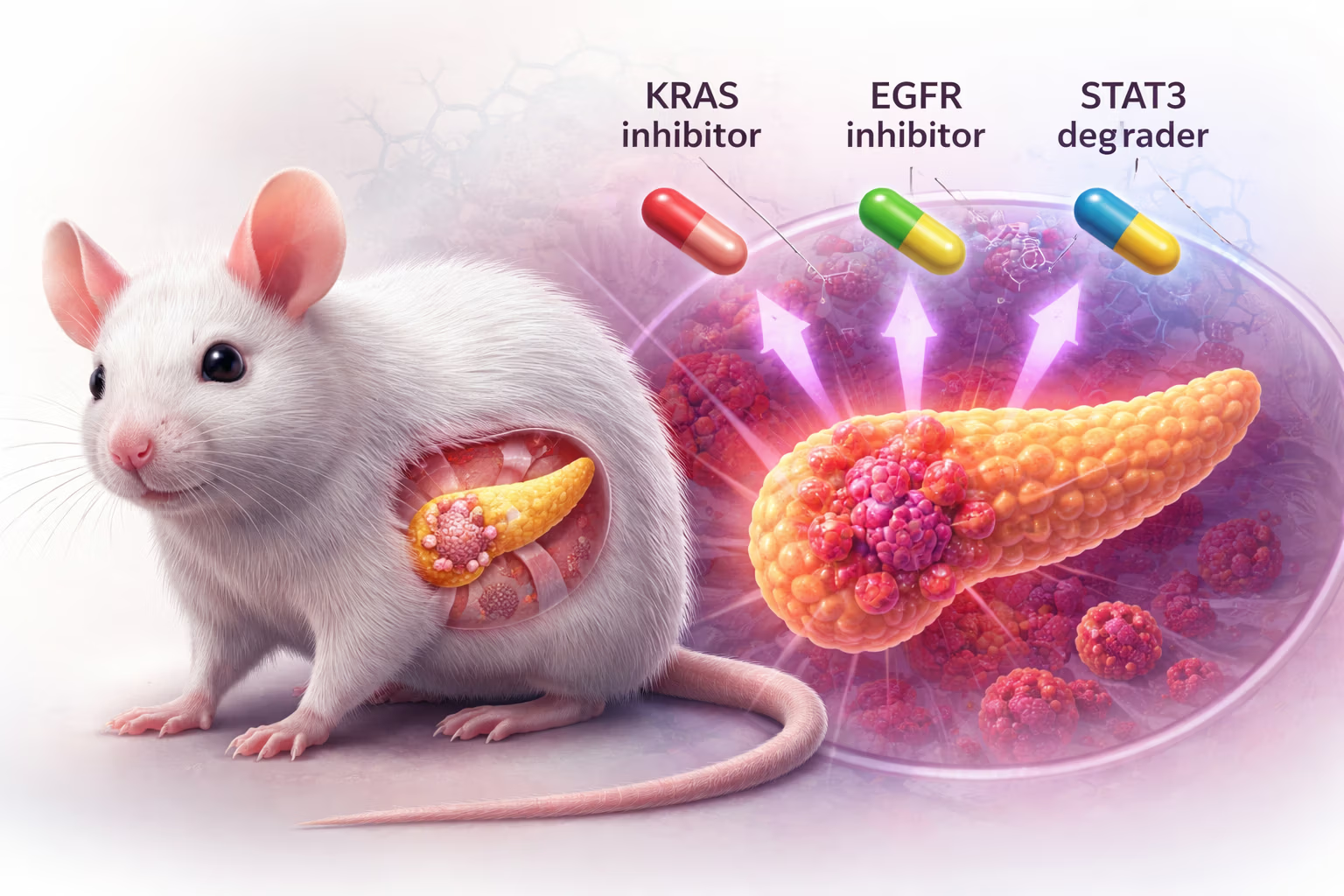
- A triple combination of a KRAS inhibitor (daraxonrasib/RMC-6236), an EGFR family inhibitor (afatinib), and a STAT3 degrader (SD36) induced complete and durable tumour regression in multiple PDAC mouse models and patient-derived xenografts.
- There was no evidence of tumour resistance for over ~200 days after treatment in mice, a notable advance over existing single-agent strategies.
- The combination was well tolerated in animal models with no significant toxicities observed.
Clinical implications:
- These findings provide a strong preclinical rationale for future clinical trials of rational combination therapy targeting multiple KRAS pathway nodes in PDAC.
- While promising, translation to humans remains uncertain; therapies effective in mouse models do not always replicate in patients.
To counter this, the research team led by Mariano Barbacid and colleagues pursued a strategy of simultaneous inhibition of multiple signalling nodes in the KRAS pathway rather than targeting KRAS alone.
Researchers combined three distinct agents:
- a selective KRAS inhibitor (RMC-6236/daraxonrasib) targeting mutant KRAS signalling,
- an EGFR family inhibitor (afatinib) blocking upstream receptor signalling, and
- a STAT3 protein degrader (SD36) acting on a parallel effector pathway.
When applied to orthotopic murine PDAC models, genetically engineered mouse tumours, and patient-derived xenografts (PDX), this triple therapy produced complete tumour regression with no detectable regrowth for over 200 days following treatment — a remarkable duration in preclinical cancer research. Tumour shrinkage was sustained, and the animals tolerated the regimen well with no significant toxicity reported.

Featured Event
These findings represent a significant advance in rational combination therapy design, illustrating that pre-emptively blocking multiple escape routes can suppress both tumour growth and resistance mechanisms far more effectively than single-agent approaches. However, caution is warranted: mouse models do not fully recapitulate human PDAC biology, and many promising preclinical therapies ultimately fail in early clinical trials due to differences in tumour complexity, microenvironment, and drug metabolism.
The authors emphasise that while these results “open the road” to new therapeutic strategies for PDAC, further work is needed to adapt this combination for human clinical trials.
Challenges include identifying clinically available or optimised inhibitors for each target node and carefully assessing safety and efficacy in humans.
This study lays the groundwork for future translational research in pancreatic cancer, demonstrating that multi-node blockade of KRAS signalling can induce profound and durable tumour regression in preclinical models.
While clinical relevance remains to be proven, the approach exemplifies next-generation combination therapy design that may ultimately provide more durable control of one of oncology’s toughest challenges.
Paper: V. Liaki, et al. A targeted combination therapy achieves effective pancreatic cancer regression and prevents tumor resistance, Proc. Natl. Acad. Sci. U.S.A. 122 (49) e2523039122, Access online here.
Funding: This study has been funded by Fundación CRIS Contra el Cáncer; the European Research Council (ERC); the State Research Agency, through co-financing with the European Regional Development Fund; Next Generation EU funds; the Biomedical Research Networking Centre (CIBERONC); and the Carlos III Health Institute.
About the National Cancer Research Centre (CNIO): The National Cancer Research Centre (CNIO) is a public research centre under the Department of Science, Innovation and Universities. It is the largest cancer research centre in Spain and one of the most important in Europe. It includes around five hundred scientists, along with support staff, who are working to improve the prevention, diagnosis, and treatment of cancer.