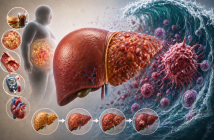


 The mechanisms that allow the liver to repair and regenerate itself have long been a matter of debate. Now researchers at University of California, San Diego School of Medicine have discovered a population of liver cells that are better at regenerating liver tissue than ordinary liver cells, or hepatocytes.

The study, published August 13 in Cell, is the first to identify these so-called “hybrid hepatocytes,” and show that they are able to regenerate liver tissue without giving rise to cancer. While most of the work described in the study was done in mouse models, the researchers also found similar cells in human livers.
In this latest study, led by Michael Karin, PhD, Distinguished Professor of Pharmacology and Pathology, researchers traced the cells responsible for replenishing hepatocytes following chronic liver injury induced by exposure to carbon tetrachloride, a common environmental toxin. That’s when they found a unique population of hepatocytes located in one specific area of the liver, called the portal triad. These special hepatocytes, the researchers found, undergo extensive proliferation and replenish liver mass after chronic liver injuries. Since the cells are similar to normal hepatocytes, but express low levels of bile duct cell-specific genes, the researchers called them “hybrid hepatocytes.”
Meanwhile, many other research labs around the world are working on ways to use induced pluripotent stem cells (iPSCs) to repopulate diseased livers and prevent liver failure.
“Although hybrid hepatocytes are not stem cells, thus far they seem to be the most effective in rescuing a diseased liver from complete failure,” said Joan Font-Burgada, PhD, postdoctoral researcher in Karin’s lab and first author of the study.
While iPSCs hold a lot of promise for regenerative medicine, it can be difficult to ensure that they stop proliferating when their therapeutic job is done. As a result, iPSCs carry a high risk of giving rise to tumours. To test the safety of hybrid hepatocytes, Karin’s team examined three different mouse models of liver cancer. They found no signs of hybrid hepatocytes in any of the tumours, leading the researchers to conclude that these cells don’t contribute to liver cancer caused by obesity-induced hepatitis or chemical carcinogens.
“Hybrid hepatocytes represent not only the most effective way to repair a diseased liver, but also the safest way to prevent fatal liver failure by cell transplantation,” Karin said.
[hr]
Source: University of California – San Diego