

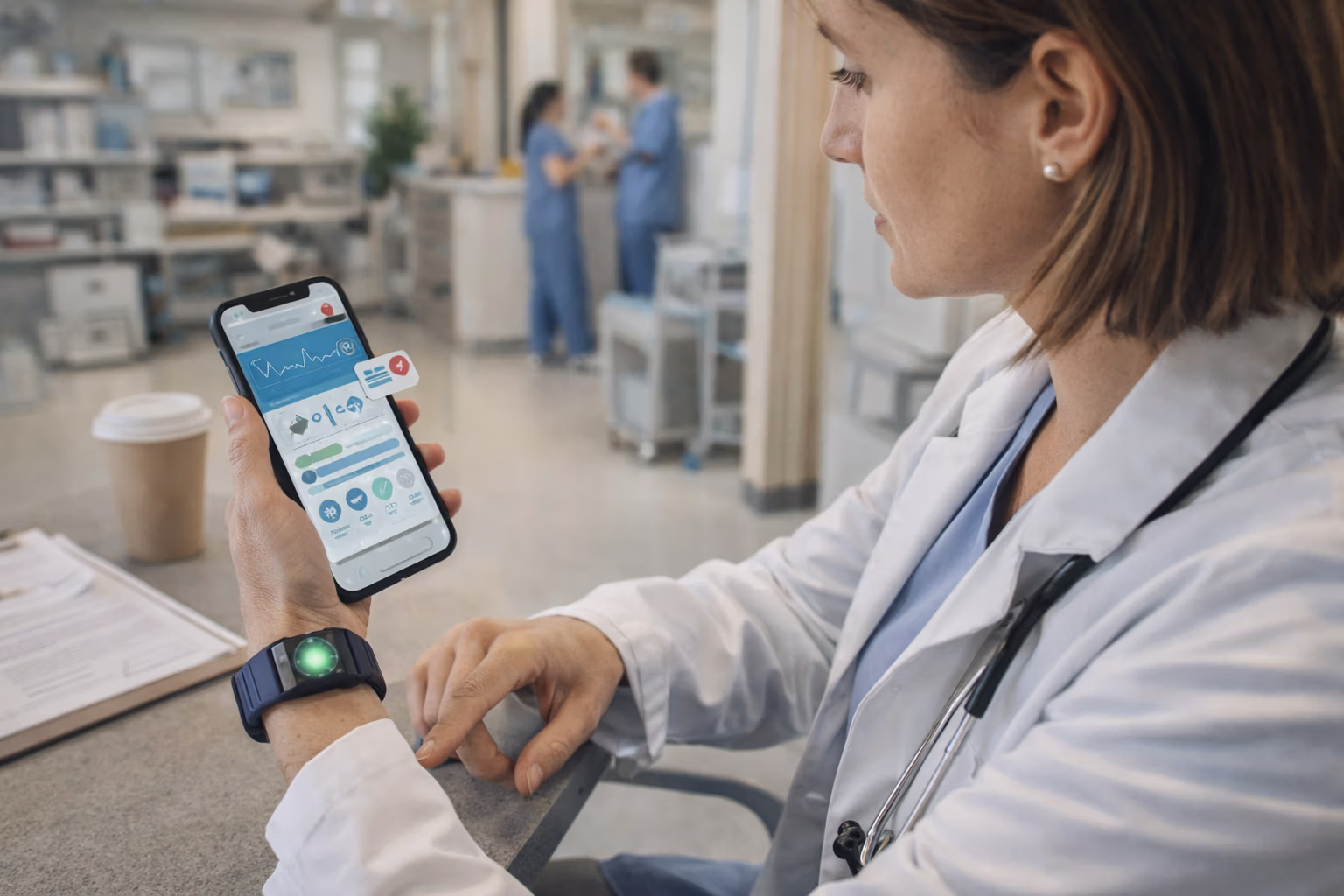
Burnout among health care professionals has become a persistent and pressing issue, especially in high-stress specialties such as oncology, emergency medicine, and critical care. A new prospective cohort study published in JAMA Network Open evaluated whether participation in an 8-week asynchronous app-based personalised coaching intervention — augmented by biometric data from a wearable sensor — was associated with meaningful changes in clinician well-being, burnout, professional fulfilment, and self-valuation. The findings suggest that engaging with such technology-enabled coaching platforms may be a feasible strategy for supporting healthcare workers’ well-being in demanding clinical environments.
Recognising the urgency of addressing clinician burnout, the study was conducted within a large US health care system across four service lines: critical care, women’s health, heart and vascular, and emergency medicine. Clinicians and other health care professionals were recruited between June 2024 and August 2024, and those who completed both baseline and 8-week assessments were included in the analysis. A total of 192 participants (mean age 42.5 years; 70.3% female) completed both assessments. Nearly half were attending physicians, with advanced practice clinicians and nurses also represented.
CLINICAL SUMMARY

What was examined
Participation in an 8-week asynchronous, app-based personalised coaching intervention informed by wearable biometric data, and its association with validated measures of clinician burnout, professional fulfilment, and self-valuation.
Key findings
-
Mean burnout scores on the PFI decreased (from 2.4 to 1.8), while professional fulfilment increased (from 3.1 to 3.8) over 8 weeks (both P < .001).
-
On the MBI-HSS, emotional exhaustion decreased (27.5 to 21.0), depersonalisation decreased (8.6 to 6.2), and personal accomplishment increased (38.4 to 42.7) (all P < .001).
Clinical implications
-
Biometric-informed digital coaching may offer a scalable approach to support clinician well-being, including in high-stress fields like oncology.
-
Controlled studies are needed to determine whether such interventions causally reduce burnout and to evaluate their impact on clinical performance, retention, and patient care outcomes.
Participants used a wearable photoplethysmography sensor paired with an asynchronous mobile coaching platform tailored to their biometric signals. Validated measures of burnout and well-being were obtained at baseline and after the 8-week intervention using two established instruments: the Stanford Professional Fulfillment Index (PFI) and the Maslach Burnout Inventory Human Services Survey (MBI-HSS). Across all evaluated domains, scores changed in directions consistent with reduced burnout and improved professional fulfilment and self-valuation.
Specifically, mean overall burnout scores on the PFI decreased from 2.4 at baseline to 1.8 at 8 weeks (P < .001), while professional fulfilment scores increased from 3.1 to 3.8 (P < .001). Self-valuation scores also improved significantly over the intervention period. On the MBI-HSS instrument, emotional exhaustion scores decreased from a mean of 27.5 to 21.0 (P < .001), depersonalisation scores decreased from 8.6 to 6.2 (P < .001), and personal accomplishment increased from 38.4 to 42.7 (P < .001), reflecting reductions in core burnout domains and enhancements in clinicians’ sense of efficacy.

Featured Event
These changes were statistically significant and suggest effect sizes that are meaningful in real-world clinical practice. Emotional exhaustion — a hallmark of burnout that has been linked to clinician turnover, reduced patient satisfaction, and increased medical error rates — showed measurable improvement. Depersonalisation, another core aspect of burnout that can erode empathy and patient-clinician relationships, also decreased. Personal accomplishment, which reflects clinicians’ sense of efficacy and professional value, increased substantially over the 8 weeks.
For oncology teams, where cumulative stress, intensity of patient loss, and emotional labour are often higher than in many other specialties, strategies that support clinician well-being may have downstream benefits for both providers and patients. Burnout in oncology is associated not only with workforce attrition but also with compromised communication, reduced time for supportive care, and impaired interdisciplinary collaboration — all of which can affect patient experience and outcomes. Digital coaching platforms that integrate biometric feedback may offer a scalable way to help cancer clinicians monitor stress signals, build resiliency,e and sustain professional fulfilment amidst challenging workloads. Future research could explore how tailored interventions like this perform specifically within oncology care settings, where the interplay between clinician stress, compassion fatigue, and the emotional demands of cancer care is particularly acute.
This study’s design was observational and lacked a control group, which limits causal inference; improvements in well-being cannot be definitively attributed to the coaching intervention alone. However, the consistency of improvements across validated burnout and fulfilment domains supports the potential utility of biometric-informed coaching models. Larger controlled trials, ideally with longer follow-up and investigation of the physiological–psychological interface, could clarify whether wearable-linked digital coaching can mitigate workplace burnout more effectively than existing supports.
Paper: Leo T, et al. Assessment of Clinician Well-Being Using a Biometric-Informed Coaching Platform. JAMA Netw Open. 2026;9(2):e2558865. doi:10.1001/jamanetworkopen.2025.58865 Access online here.