
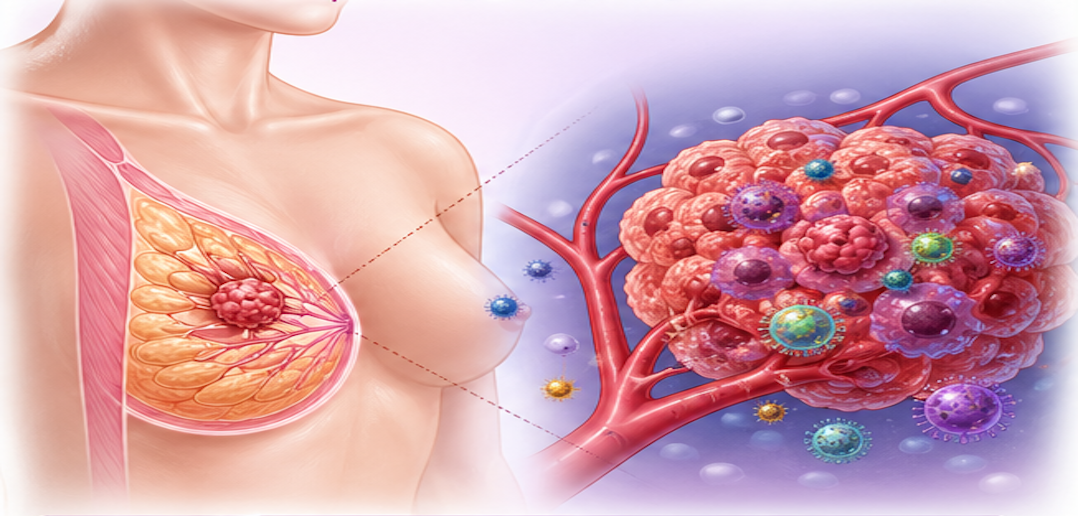
Breast cancer (BCA) is one of the most common cancers worldwide, with high mortality and morbidity in women. This review focuses on the applications of nanotechnology, nanomaterials (NMs), and nanoparticles (NPs) in BCA diagnosis and therapy. Nanotechnologies, nanocarriers, and nano-encapsulation versus conventional counterparts are discussed. Various drug formulations into lipid NPs, nanoemulsions, polymeric NPs, and metal-based NPs enhance bioavailability and therapeutic efficacy, overcoming limitations of conventional formulations. Clinical specialists have achieved improved outcomes in BCA detection and monitoring using nanotechnology, ultimately improving patients’ quality of life.
Breast cancer accounts for 30% of all cancer cases and 15% of cancer‑related deaths in women. The PI3K/AKT/mTOR signalling pathway plays a crucial role in BCA development and progression. Nanomedicine applies NMs and NPs for prevention, diagnosis, and treatment. This review addresses challenges of conventional therapies (lack of target specificity, drug resistance, systemic toxicity) and highlights how nanotechnology overcomes these limitations.
NMs have at least one dimension in 1–100 nm and a large surface‑to‑volume ratio, conferring novel properties. Reducing particle size increases solubility and surface interactions. Nanotechnology improves pharmacokinetics, enables targeted delivery, enhances permeability and retention effects in tumours, and reduces required drug doses.
Conventional carriers have limited tumouur response and affect normal cells. Nanocarriers include lipid nanoparticles (LNPs), nanoemulsions (NEs), polymeric NMs, and metallic NPs. They enhance drug stability, absorption, encapsulation efficiency, bioavailability, and controlled release. NEs improve the oral delivery of poorly soluble drugs and reduce toxicity.
Chitosan‑based nanocarriers exploit electrostatic interactions with cancer cells, enhance cellular uptake, and open tight junctions. Quaternary ammonium chitosan improves penetration. Chitosan NPs deliver genes, drugs, and natural compounds; induce phototherapy‑mediated tumor ablation; and support combination therapy.
Clinical results: Nanocarriers improved drug delivery and outcomes. Photothermal nanomaterials (PTT) with nanotechnology-enhanced metastatic BCA treatment reduced damage to healthy cells and synergized with chemotherapy/immunotherapy. Cyclophosphamide NEs in rats showed remarkable tumor reduction. Exemestane‑loaded polymer‑lipid hybrid nanoparticles (PLH NPs) improved oral bioavailability (>3.5‑fold) and tumor inhibition (62% vs. 31% for conventional suspension) in mice.
Major Metallic Nanocarriers
- Gold (Au) NPs: Biocompatible, easy surface modification, effective against TNBCA via Rad6 conjugation, inducing mitochondrial dysfunction. Clinical translation is limited by toxicity in the liver, kidneys, and spleen.
- Silver (Ag) NPs: High photon attenuation; ethyl cellulose‑coated Ag NPs inhibited TNF‑α in BCA cells.
- Copper (Cu) NPs: Bioactive; 5‑fluorouracil loaded into β‑cyclodextrin‑Cu NPs showed sustained release and anticancer activity against TNBCA.
- Iron oxide (Fe₃O₄) NPs: Magnetic core‑shell NPs (Fe₃O₄‑poly(N‑isopropylacrylamide)‑grafted chitosan) delivered methotrexate with 94% entrapment efficiency; enhanced antitumor activity against MCF‑7 cells at 40°C and pH 5.5.
Nanotechnology offers major advantages: targeted delivery, controlled release, reduced toxicity, and improved efficacy. However, knowledge gaps exist regarding NM toxicity, safety, and interactions with organs. Toxicity assessment and risk evaluation are needed before clinical translation.
Nanotechnology, NMs, nanocarriers, and nano‑encapsulation are more effective than conventional technologies and bulk materials for BCA diagnosis and therapy. Reducing drug particle size enhances targeting and release kinetics. Various formulations (lipid NPs, NEs, polymeric NPs, PLH NPs, metal‑based NPs) improve bioavailability and overcome conventional limitations. Clinical specialists have achieved better BCA detection and monitoring, leading to improved quality of life and prolonged survival. TNBCA remains aggressive, and nanotechnology offers promising strategies for its treatment.
Source: Xia & He Publishing Inc.