
By Prof. Martin Widschwendter, Director, The Daffodil Centre, a partnership between Cancer Council NSW and the University of Sydney
Cancer’s global burden continues to rise – not because medicine has failed, but because we have, until now, waited too long. Survival rates for many cancers have improved significantly over recent decades, yet incidence continues to climb. The most powerful lever remaining is prevention: stopping cancers from developing in the first place, and detecting them at the earliest, most treatable stage when intervention is least burdensome and outcomes are best.
This is the founding conviction of the Daffodil Centre, a partnership between Cancer Council NSW and The University of Sydney, and it drives our entire strategic direction. Our ambition is to become the world’s leading research centre for P4 cancer prevention: research that is Predictive, Preventive, Personalised, and Participatory. At the scientific heart of this mission is a field that has quietly transformed our understanding of cancer biology: epigenomics.
What is epigenetics and why does it matter for oncology?
The genome is often described as a blueprint. But a blueprint alone does not determine outcomes. It is the regulatory machinery sitting above the DNA sequence that controls which genes are switched on or off, in which cells, and at what times. This is the domain of epigenetics.
The most studied and clinically actionable epigenetic mechanism is DNA methylation – the addition of methyl groups to cytosine residues, typically at CpG dinucleotides. These marks are heritable across cell divisions, respond dynamically to environmental exposures, and function as a fundamental layer of cellular programming. Critically for oncology, aberrant methylation patterns, particularly at gene promoters, are among the earliest measurable disruptions of normal cellular biology in carcinogenesis, often appearing years to decades before a tumour becomes clinically apparent.
Several features make epigenetic biomarkers particularly compelling in the prevention context:

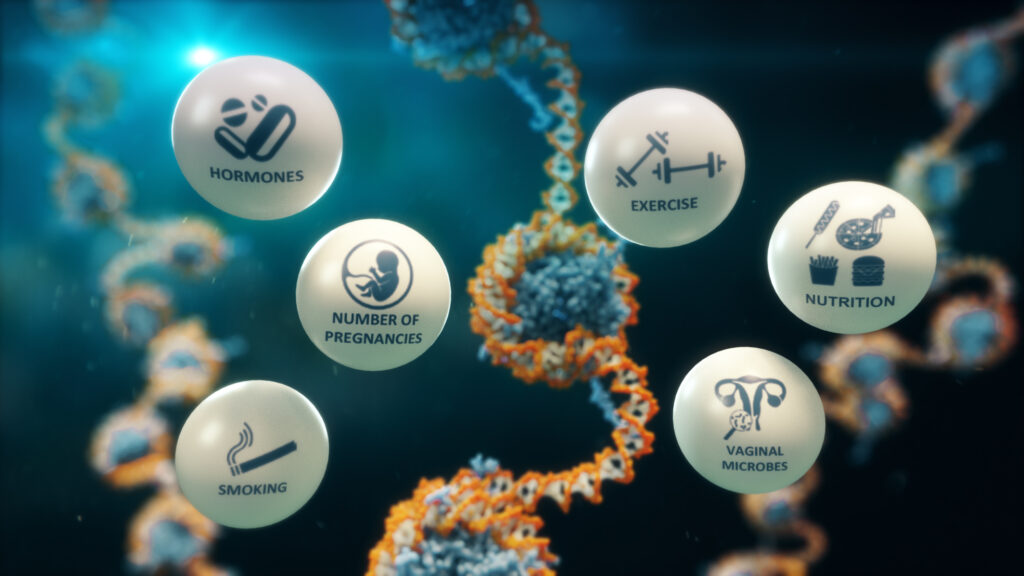
DNA methylation – a key epigenetic mark – is dynamically shaped by a wide range of modifiable exposures across the life course, including hormonal milieu, reproductive history, smoking, physical activity, nutrition, and the vaginal microbiome. Because these marks accumulate in measurable patterns years before cancer develops, they serve simultaneously as biological sensors of cumulative risk and as potential targets for preventive intervention. Unlike fixed germline genetic variants, epigenetic marks are malleable – making the epigenome both a readout of past exposures and a modifiable determinant of future cancer risk.
 REGISTER FOR BREAST CANCER TRIAL’S ANNUAL SCIENTIFIC MEETING | JULY 2026
They are dynamic and exposure-responsive
Unlike germline genetic variants, DNA methylation patterns are modifiable. They change in measurable, dose-responsive ways following exposure to tobacco, alcohol, obesity, environmental carcinogens, reproductive hormones, and other established cancer risk factors. This makes them both biological sensors of cumulative exposure and potential intermediate endpoints in prevention trials – something genetic markers alone cannot offer.
They are detectable non-invasively
Methylation signatures can be interrogated from blood, urine, cervicovaginal swabs, and buccal samples – including self-collected specimens. This transforms the scalability of cancer risk assessment at population level.
They carry tissue-of-origin information
Tissue-specific methylation patterns in cell-free DNA allow inference of where in the body an epigenetic signal originates, enabling multi-cancer risk assessment from a single sample – a capability that underpins the next generation of multi-cancer early detection (MCED) tests.
Epigenomics and the P4 Medicine Framework
The Daffodil Centre organises its research around the P4 Medicine framework, developed by systems biologist Leroy Hood, which holds that health systems should become Predictive, Preventive, Personalised, and Participatory. Applied to cancer prevention, epigenomics supports all four dimensions in concrete and actionable ways.
Predictive: Epigenetic biomarkers can quantify cancer risk across multiple cancer types from a single self-collected sample. These models integrate tissue-specific methylation signatures to identify individuals at elevated risk years before any clinical sign emerges, enabling rational, risk-stratified allocation of preventive and screening resources.
Preventive: Because epigenetic marks respond to modifiable exposures, they provide mechanistic evidence that lifestyle interventions – smoking cessation, weight loss, reduced alcohol intake, increased physical activity – but also specifically targets drugs – including for instance drugs that target estrogen or progesterone receptors – actually alter the biological trajectory toward cancer. Epigenomic biomarkers can serve as surrogate endpoints in prevention trials, potentially shortening trial duration and accelerating the evaluation of strategies that reduce cancer risk before disease manifests. They also enable identification of cells with aberrant methylation as targets for pharmacological chemoprevention, including the repurposing of existing agents.
 LISTEN TO DR NIARA OLIVEIRA + DR VIVEK RATHI BUSTING SOME BRCA MYTHS!
Personalised: Current population-level screening programmes are stratified almost entirely by age and sex – a blunt instrument. Epigenomic risk profiling enables stratification by individual biological risk, moving towards precision screening where those at highest risk are detected earliest and most intensively, and those at low risk are spared unnecessary procedures. For breast cancer, this means integrating epigenomic indices with polygenic risk scores, mammographic density, and lifestyle factors to individualise screening intervals and modalities. For cervical cancer, DNA methylation markers are being evaluated as a replacement for cytology in triaging HPV-positive women. For colorectal cancer, epigenetic and genomic biomarkers in self-collected stool and blood samples may substantially improve participation in under-screened populations.
Participatory: Accessible, actionable risk information – communicated appropriately – empowers individuals to understand and modify their cancer risk. Self-sampling-based epigenomic tests lower the participation threshold, particularly for under-screened populations including those in rural and remote areas, lower socioeconomic groups, and culturally and linguistically diverse communities. Prevention gains are only meaningful if they are equitably distributed.
What This Means in Practice
The Daffodil Centre’s research translates this framework into concrete clinical and public health initiatives across two overarching pillars.
Primary prevention focuses on reducing cancer incidence by modifying the conditions in which cancers arise – spanning risk factor epidemiology (tobacco, alcohol, obesity), epigenetic biomarker development linked to modifiable exposures, chemoprevention, vaccine-based prevention, and community engagement. A distinctive focus is on prenatal and early-life epigenomics as determinants of long-term cancer risk trajectories – a largely unexplored frontier with significant implications for population health.
Secondary prevention focuses on detecting cancer at its earliest possible stage through precision, biologically-informed screening. This includes risk-stratified national screening programmes, multi-cancer early detection using epigenomic approaches from self-collected samples, and precision surveillance for individuals with hereditary cancer syndromes or high-risk epigenetic profiles.
Cutting across both pillars is a commitment to implementation science – because scientific advances in early detection only reduce cancer mortality when successfully translated into policy and practice at scale.

The Vision Ahead
Australia’s population-level cancer screening programs – currently designed around age and sex – represent an enormous opportunity for modernisation. The single highest-impact application of the P4 framework at population scale is their transformation into precision programs stratified by individual biological risk. This is what the Daffodil Centre strives to achieve.
Epigenomics is not a replacement for genetics, epidemiology, or clinical judgment. It is the molecular bridge between our environment and our cancer risk – the layer of biology that connects exposure to mechanism, mechanism to risk, and risk to actionable prevention. It is what makes precision prevention not merely a concept, but a clinical and public health reality within reach.
For healthcare professionals, this represents an emerging evidence base to engage with and a shift in how we conceptualise our role: from treating disease after it arises, to predicting and preventing it before it does.
About the Daffodil Centre
The Daffodil Centre is a partnership between Cancer Council NSW and The University of Sydney. Directors are Prof. Martin Widschwendter (Cancer Council NSW) and Prof. Anne Cust (University Sydney). It plays a leading role in cancer prevention, early detection and control delivering world class research, providing evidence to inform policy and practice in Australia and internationally.
For more information, visit www.daffodilcentre.org