

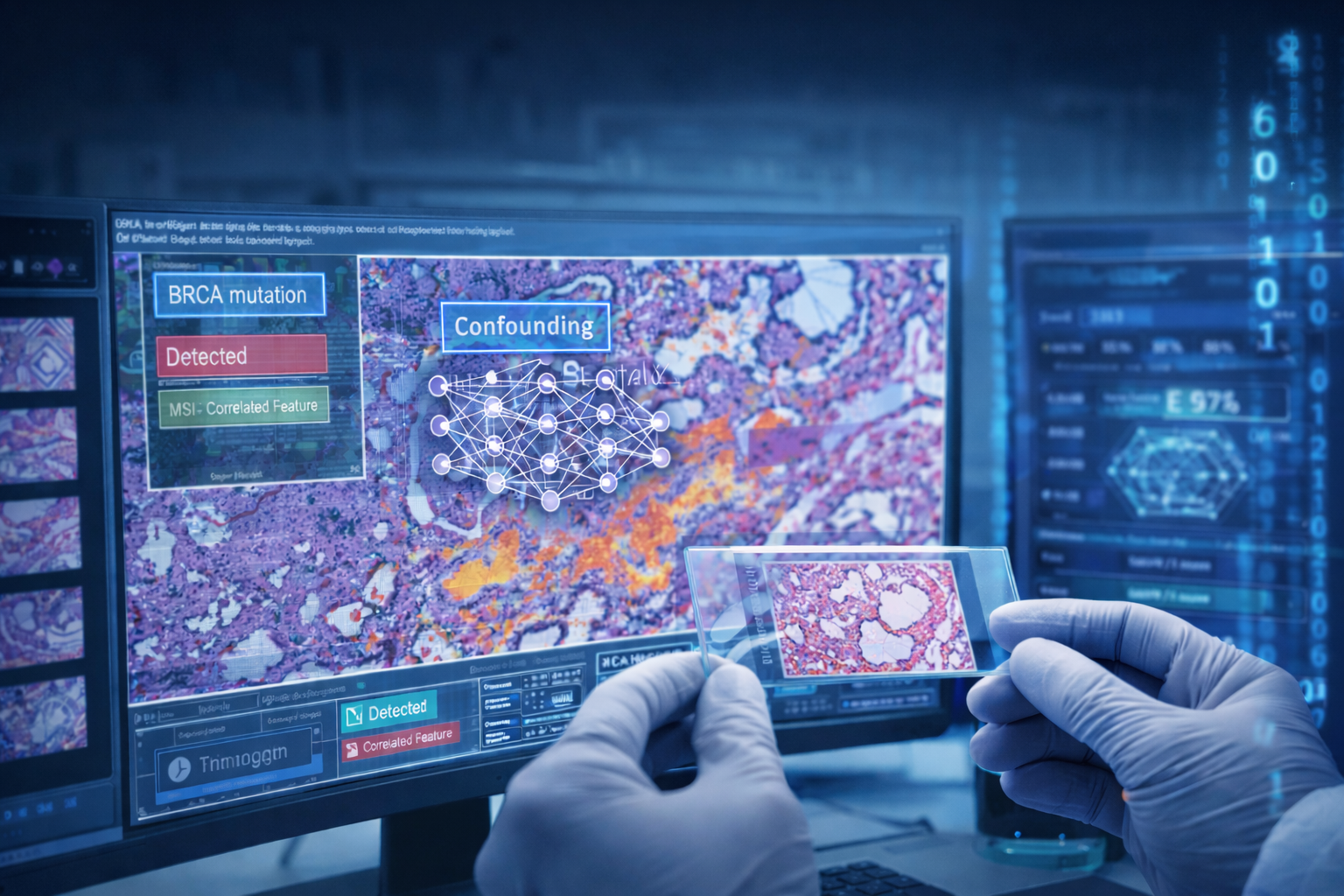
Artificial intelligence models designed to predict tumour molecular biomarkers from routine pathology images may rely on correlations between biomarkers and clinicopathological features rather than true biomarker-specific morphological signals, according to a new analysis published in Nature Biomedical Engineering.
Computational pathology approaches increasingly use deep learning models to analyse haematoxylin and eosin (H&E)–stained whole-slide images to infer clinically relevant molecular biomarkers, including gene mutations and receptor status. These tools have been proposed as rapid, low-cost alternatives to molecular testing.
CLINICAL SUMMARY
What was examined
What was examined
Researchers evaluated whether deep learning models can reliably predict tumour molecular biomarkers from routine histopathology whole-slide images across multiple cancer types.
Key findings
-
AI models predicting biomarker status from pathology images were strongly influenced by interdependencies between biomarkers and clinicopathological variables.
-
Apparent high accuracy often reflected correlations between biomarkers, rather than the detection of biomarker-specific morphological signals.
-
Model performance often declined when evaluated within patient subgroups defined by other biomarkers or tumour characteristics.
Clinical implications
-
Current computational pathology models predicting molecular biomarkers from histology slides should not replace molecular testing.
-
AI pathology tools may still have value as triage or complementary decision-support systems.
-
Future models may need improved evaluation methods and training approaches to reduce bias and improve reliability.
However, the new study suggests that many of these models may not be learning the biological effects of individual biomarkers. Instead, their predictions may depend on correlations between biomarkers or clinicopathological features present in the training data.
The researchers analysed more than 8,000 tumour samples across multiple cancer types, examining how relationships between biomarkers influence model performance.

Featured Event
Although AI models often achieved high overall accuracy, further analyses showed that predictive performance often declined when patients were stratified according to other biomarker statuses or clinicopathological variables. This suggests that models may be exploiting confounding relationships rather than learning biomarker-specific morphological signals.
For example, models predicting specific gene mutations could rely on correlated features such as microsatellite instability rather than detecting morphological signatures of the mutation itself. When those correlations were absent, prediction accuracy often declined.
The authors note that this phenomenon—sometimes described as “shortcut learning”—can create misleading performance metrics and may limit the reliability of AI tools if deployed in clinical settings.
While AI-based pathology models remain promising, the findings highlight the need for improved model design, more rigorous evaluation methods, and training datasets that better account for biomarker interdependencies.
The researchers conclude that current approaches are not yet suitable as substitutes for molecular testing, but may still have a role in triage or as complementary tools if their limitations are carefully considered.
Paper: Dawood, M., Branson, K., Tejpar, S. et al. Confounding factors and biases abound when predicting molecular biomarkers from histological images. Nat. Biomed. Eng (2026). https://doi.org/10.1038/s41551-026-01616-8. Access online here.